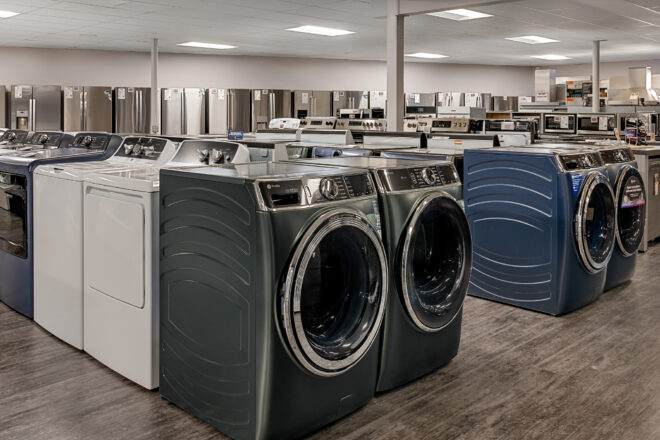
What Are The Benefits Of A Front Loading Washing Machine?
One of the biggest questions asked these days by many consumers is, “What is the benefit of a front-loading laundry pair and why should I purchase one?” It’s certainly a good question, and there are plenty of benefits that may cause you to think about upgrading your old top-loading pair of laundry.
One of the biggest questions asked these days by many consumers is, “What is the benefit of a front-loading laundry pair and why should I purchase one?”
It’s certainly a good question, and there are plenty of benefits that may cause you to think about upgrading your old top-loading pair of laundry. If you’re finding that your washing performance has dropped off, or there are other reasons why you’ve decided it’s time for a new washer and dryer, purchasing a new front-loading pair may end up saving you money over the long term while also making the task of doing laundry a little easier.
Water Usage: The Hidden Cost of Top Loaders
Water consumption has become a big topic of discussion recently, and this is obviously the first topic we’ll talk about. If you have an older top-loading washing machine, you probably have no idea just how much water you’re using each time you do a load of laundry. Many of those older machines typically used somewhere between 45-55 gallons of water per load.
This may not seem that bad on paper and may look like just a number, but imagine going to the grocery store and having to purchase 50 one-gallon bottles of spring water. This is an average of how much water is used each time a load of laundry is done in one of those machines. Many of them did have the ability to adjust the load size to help lower that number, but it’s still too high by today’s standards for what is needed to effectively get the clothes clean.
Efficient Design and Larger Loads
In a front-loading washing machine (and even in the majority of newer high-efficiency top-loading washers), that number is lowered dramatically. Most of the newer front-loading washers use an average of somewhere between 10-18 gallons (depending on the model). However, one key difference is that you’re using this amount of water with a load of laundry that could be as much as 2-3 times larger than what could be washed in a regular top-loading washer.
As you probably have seen, front-loading washers don’t have an agitator, so as long as you can comfortably close the washer door (without forcing it) you can completely fill the drum full of clothes. The machine will then sense how full the drum is, and it will fill with the appropriate amount of water. So whether you’re doing a small or large load, you’ll always use the correct amount of water.
Detergent and Fabric Softener Considerations
One thing we’ll touch on briefly, is the use of laundry detergent, fabric softener, and bleach inside these machines. Since these machines use so much less water than a traditional washing machine, they require a different type of detergent. The type of detergent recommended is a high efficiency (HE) detergent, and these can be purchased at any local supermarket and is usually located with its ‘non HE’ counterpart. Look on the lower corner of the bottle and you’ll likely see that symbol which designates this.
The reason why this type of detergent is needed is because this is a higher concentration formula and it’s also a lower sudsing detergent, and allows for proper rinsing of the clothes. If you used the same amount of regular detergent in these machines you would be required to add additional rinses, but more importantly it could lead to potential service calls.
Bleach and Water Temperature Boosting
The next thing we’ll talk about is the use of bleach in these machines. On many of these machines, bleach is no longer needed. As you probably know bleach isn’t very good for your clothes, and it’s bad for fabrics. However, the reason why it’s needed is because the temperature of the water usually isn’t hot enough to effectively get the clothes clean.
Since most people set their water heaters around 120-degrees, at that temperature the fabrics don’t open up enough for the detergent to get in and clean properly. Many of these newer machines now boost the water temperature up to 150-160 (some even reach 200) degrees. This allows the detergent to get in and clean the clothes properly without bleach, and in most cases also sanitizes* the clothing.
Longer Cycles, But Minimal Energy Use
While this type of load of laundry does require a much longer cycle (an average of 90 minutes), the amount of energy used is actually minimal. The water is usually heated using a “flow through” water heater, which heats the water before it even enters the machine. It’s then cycled back out and then passes through the heater again so that the temperature increase is gradual, which is why the fabrics aren’t “shocked” with hot water, so there’s no fear of shrinking on most fabrics*. Many people also wonder if this uses more energy, but this is, in fact, an extremely energy-efficient way of heating water; it simply requires more time.
Caption: Gradual water heating protects fabrics while reducing energy use.
The best way to describe this is to imagine driving in your car on a long trip. If you drive at 75mph, you’ll arrive at your destination sooner, but you’ll use far more fuel than if you drove 55mph instead. Once you try this cycle, you’ll probably find that your whites will be much whiter, and you’ll no longer have to use this harmful chemical when doing these loads.
Timed Fabric Softener and Bleach Dispensers
Most washers also have a fabric softener dispenser, which is on a time release system and is added at the necessary point of the wash cycle, so there’s no need to wait until the right time to add it. Many machines do still include a bleach dispenser, so the same holds true for bleach as there are many of the lesser models that don’t heat the water to the aforementioned temperatures which will still make it necessary to properly get your whites clean.
Faster Spin Cycles = Shorter Drying Times
While these machines are extremely energy efficient on their own, they also cut your dry times dramatically since they spin out much faster than a traditional top loading machine. Most top loaders usually max out at 600rpm, but most of these newer front loading washers spin out at around 1000rpm* which you’ll find leads to drying times that average 35 to 45 minutes (and sometimes even shorter) depending on the size of your load. Compare that to the 60-90 minutes that you’re probably use to, and the savings can be significant.
Final Thoughts: Smart Laundry That Saves
There are many different benefits to upgrading your laundry pair. You can do more laundry with better results, while also extending the life of your clothes. More importantly it may be an investment that in the long run could also end up saving you time and money.
*Cycles can vary based on each machine. Always follow wash instructions included with your garments.