Five Things To Consider When Purchasing a New Electric Range
It’s time for a new electric range, but if you’re like most people, it’s probably been quite a while since the last time you purchased one.
It’s time for a new electric range, but if you’re like most people, it’s probably been quite a while since the last time you purchased one. You’re also probably wondering what features to look for as you begin shopping for a replacement. Many people often come in wondering about measurements, but the vast majority of ranges are a standard 30-inch width, so just take a quick width measurement of your opening (not your existing range) to make sure that is indeed the case in your application.
Also, unplug your existing range and check to see if you have a three or four-prong cord. This is important since there are two applications, and ranges no longer come with cords. So be sure to let your salesperson know which one you need.
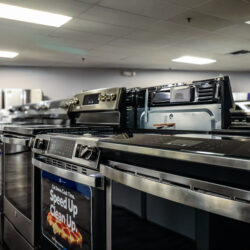
In the meantime, here are five things you may want to think about before you come into our showroom.
1) Glass Top or Coils? – One of the most common questions is “Do I want a glass top or coil top range?” The answer for the most part is usually that a glass top range is recommended for easier cleanup, faster heating, etc. However, many people aren’t aware that there are some minor restrictions in regards to the type of cookware that can be used with them. It is recommended that you use stainless steel flat bottom cookware and avoid using cast iron or glass, as those two items can potentially scratch or damage your cooktop. If you’re in a situation where the vast majority of cookware you own is made up of either of these two materials, you may want to select a coil range instead.
2) What burner configuration do I need? – When it comes to electric ranges, there are many different cooktop configurations. There are ranges with four burners, warming zones, expandable burners, bridge burners, etc. There are 6-inch, 9-inch, 10-inch, 12-inch, and many other different size burners. If you have any large pots, pans, etc., take a quick moment to measure some of your larger pans to see if you need a bigger burner to accommodate it. If the thought of being able to keep food warm on the top of your range appeals to you, you may also want to consider a warming zone as well.
3) Convection or Not Convection? – This is probably one of the most common questions asked as customers come in to purchase their new range. There is no right or wrong answer to this question, but simply whether or not this feature would be useful in terms of how you cook.
There are several benefits to convection. If the idea of being able to cook multiple trays of food appeals to you, this is certainly a feature that you may want to have. You can put in multiple trays of cookies, or be able to bake a turkey on one rack and then slide a tray of dinner rolls underneath it. Most ovens are now quite large and this feature will allow you to utilize all of it.
Another benefit is that you do get much more even results with convection. For example, if you’ve baked a pie and had the top of your crust be overcooked while having a soggy bottom, convection can be a benefit. Since the heat is the same throughout the oven the crust does tend to cook more evenly, giving you a crispy crust both on the top and the bottom of your pie. An additional example would be if you’re baking a lasagna, with the even heat of convection you’ll have a nice evenly cooked lasagna with melted cheese on the top, instead of burned cheese and an undercooked bottom. You can even put your garlic bread in with the lasagna.
4) Do I Need A Warming Drawer? – If you entertain, or if you lead a busy lifestyle, a warming drawer may be a feature that benefits you. Most people find that warming drawers do tend to be quite useful for entertaining friends and family as it allows you to prepare food in advance, and then store it there until it’s time to serve it. There’s nothing more frustrating and stressful than trying to shift food around to make sure everything reaches the table hot and ready to eat. Being able to have everything ready and waiting before they even arrive may make these events more enjoyable.
Another benefit of a warming drawer may be if you or other members of your family have different work hours or after school events, it could eliminate the need of microwave reheating. Since reheating items in the microwave tends to have an adverse effect on the food, by storing it in the warming drawer it can instead be served at different times to accommodate everyone’s schedule. This is particularly useful for soups, stews, casseroles, etc. Your salesperson can also provide you with some useful suggestions as well.
5) Slide-In or Freestanding? – Now that you’ve decided what features you want, the next question will be whether or not you want a slide-in or freestanding range. The difference is with a slide-in range, the control panel is usually located on the front of the range instead of the back, while the countertop wraps around the range. A freestanding range simply fits into the space between your cabinets and countertops.
The only other decision that you’ll need to take into consideration is ventilation, which we’ll only discuss briefly here. However, if your range is going into an island or peninsula, you may want to look into purchasing a range with a built-in downdraft system. Be sure to check with your salesperson regarding both this, as well as what type of hood is recommended for your range. While not required, it’s definitely important to have some sort of vent system to make sure you can eliminate your kitchen from being filled with smoke, grease, etc.